
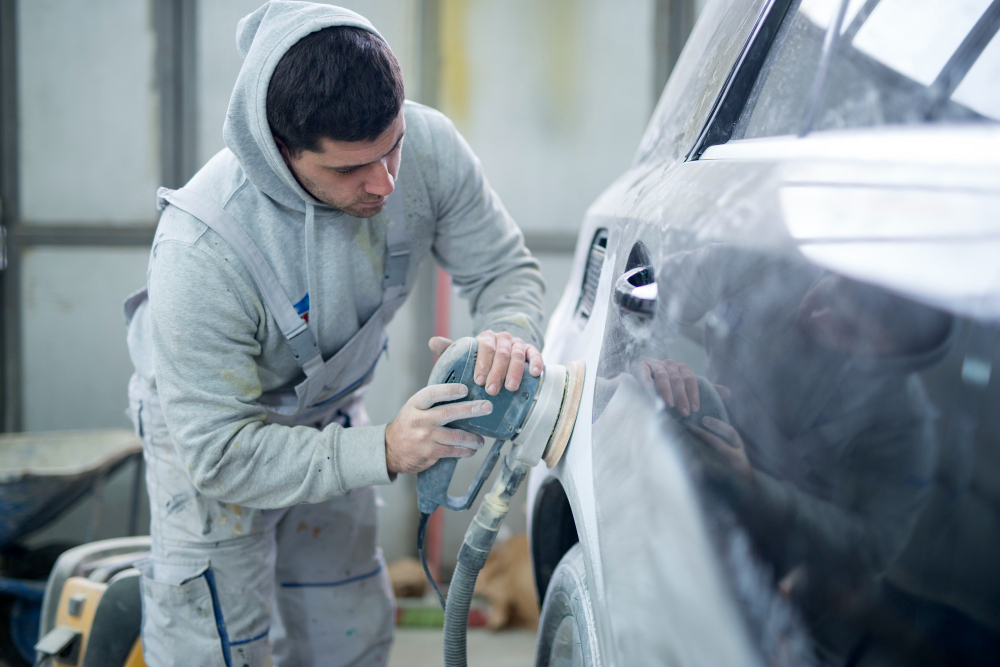
You are tired of the color. Or the clear coat on the roof and hood has gone dull, which happens quickly to any vehicle that lives outdoors in Las Vegas. Either way, you want the car to look different.
A vinyl wrap and a repaint reach a similar destination by very different routes. One is a film applied over your existing finish. The other permanently replaces it. The right call depends less on which looks better and more on the condition of your current paint, how long you plan to keep the vehicle, and whether you want the change to be permanent.
A professional Las Vegas Auto Shop can evaluate your vehicle’s paint condition and help you decide whether a vinyl wrap or a quality repaint makes more sense for your goals and budget.
The short answer
Pick a Car wrap when the factory paint is sound, you want a color or finish that is hard to get from a spray gun, or you might want to go back to original later. Wraps also suit leased vehicles and cars you expect to sell within a few years.
Pick paint when the existing finish is already failing, when panels need bodywork anyway, or when you want the change to be permanent on a vehicle you plan to keep for a long time.
The condition of your current paint decides more than anything else
Vinyl needs a sound surface. Film is thin and it follows whatever sits underneath. A dent shows through. So do prep marks. A failing clear coat is the worst case, because the adhesive grips that weak layer and can lift it when the wrap eventually comes off.
Rust, deep chips, and flaking clear coat all point toward a body shop first. A vehicle in that condition can still be wrapped later, after the repairs, but the repairs come first either way.
If the paint is straight and intact, a wrap is on the table. That single question rules out a lot of vehicles before cost ever enters the conversation.
Cost, and what actually drives it
The low end of each option is not comparable. A budget respray and a professional wrap are not the same purchase, and cheap paint shows its age fast in this climate.
Compared fairly, a professional wrap usually costs less than a high-quality refinish, because refinishing includes disassembly, sanding, primer, booth time, and reassembly. Wrap pricing moves with vehicle size, the film you choose, and how complex the body is. Deep curves, spoilers, and recessed trim all add labor, and chrome or color-shift films cost more than standard gloss and satin.
Neither has a fixed price. Ace Built quotes wrap work free after seeing the vehicle, since photos do not show the panel gaps and trim that drive the hours.
Time without your vehicle
A wrap is measured in days. Every panel gets cleaned thoroughly, film is cut to the vehicle’s dimensions, and the install happens in one continuous stretch with the car at the shop.
Paint takes longer. Panels come apart, surfaces get prepped, coats need time to cure, and the vehicle goes back together afterward. Expect noticeably more downtime, and more still if bodywork is part of the job.
Reversibility and resale value
Here is the biggest practical difference between the two. A wrap comes off, and the factory paint underneath is still factory paint.
Lease returns are the clearest case. A custom paint job on a leased vehicle can create a problem at turn-in. A wrap peels off and hands the car back in its original color.
Resale is the other. Buyers pay for original paint, and an unusual color narrows the pool of people interested in your listing. A wrapped car sells in its factory color once the film is removed. A repainted car is whatever it was painted.
Wraps also shield the paint beneath them from sun and light abrasion, so the original finish often comes out in better shape than it went in.
Finish options and partial changes
Wraps win on variety. Satin, matte, gloss, chrome, brushed metal, carbon fiber texture, and color-shift films are all catalog choices. Partial work is straightforward too. A roof, a hood, mirrors, or a chrome delete on the trim and badges shifts the whole look without touching the rest of the vehicle. Graphics and branded designs work the same way, which is the basis of fleet wraps.
Paint keeps the advantage in a few places. Multi-stage candy and pearl finishes with real depth, blends mixed for one specific vehicle, and anything involving reshaped panels belong in a booth. If your project involves both a new look and actual fabrication, our custom work team can tell you which parts we handle in-house and which need a body shop.
How each holds up in Las Vegas sun
Paint lasts longer. That is the honest answer. A quality refinish, cared for properly, holds up for many years. Wraps in desert conditions typically run around three to five years on a daily driver, and longer with garage storage and regular care. Constant UV and high surface temperatures are the reason, and we went through the details in our post on how long wraps last.
Damage repair flips the comparison the other way. A scuffed panel on a wrapped vehicle means re-wrapping that panel, and the new film matches the rest because it came from the same catalog. A scratch in paint means color matching and blending into adjacent panels, which is harder to get right and frequently costs more than replacing one section of film.
Frequently asked questions
Can you wrap a car that has peeling or damaged paint?
Not successfully. Vinyl needs a stable surface to bond to. Film applied over failing clear coat can pull that layer up during removal, which leaves you worse off than you started.
Does a wrap look as good as paint up close?
A well-installed wrap looks excellent, and most people cannot tell from a few feet away. Up close, there are seams at panel edges and recesses where film has to terminate.
Which is better for resale value?
Once the film is off, the car is back in the factory color buyers expect, and the paint underneath has been protected. A non-factory paint color narrows your buyer pool and is difficult to undo.
Can I change only part of the vehicle?
Yes, and this is where wraps pull ahead. Roof wraps, hood wraps, mirror caps, accent panels, and chrome deletes all work as standalone jobs. Examples of partial and full installs are in our project gallery.
If I just want to protect my paint, do I need a wrap?
PPF is clear, uses a self-healing surface that recovers from light scratches with heat, and is usually applied to the front end where rock chips do the most damage.
Conclusion
Neither option wins outright. Paint is permanent, repairs a failing finish, and reaches depths of color that film cannot. A wrap costs less, goes on faster, protects what is underneath, and comes back off when you want something different.
Most drivers with sound factory paint who want a new look end up with a wrap. Ace Built Automotive installs vinyl wraps and paint protection film at 5390 S. Decatur Blvd, Suite 3, and you can read what other Las Vegas drivers thought of the work in our testimonials.
Give the shop a call at 702.476.9191, or start with a free quote online. Either way, bring the vehicle by so someone can look at the paint before anything gets recommended.