
Short answer: for some vehicles here, yes. For others it is money aimed at the wrong problem.
The real answer depends on three things. How long you plan to keep the car, whether it sleeps in a garage or under the sun, and what the paint looks like now. The rest is marketing.
What a ceramic coating actually is
A ceramic coating is a liquid polymer, usually silica-based, applied to clean paint and cured into a thin, hard, semi-permanent layer bonded to the clear coat.
That bond separates it from wax or a spray sealant. Wax sits on paint and washes away in months. A cured coating becomes part of the surface and lasts years, which is the whole argument for the price.
What you get is a slicker surface. Water sheets off instead of clinging, dust and road film have less to grab, and the finish holds a deeper gloss. It also puts a sacrificial layer between UV and your clear coat, which matters more here than almost anywhere else.
What it does not do
This is where expectations go wrong and buyers feel cheated later.
A coating will not stop rock chips. It is measured in microns and has no real impact resistance. Gravel off a truck on the 15 chips coated paint exactly like uncoated paint.
The “9H” figure in the advertising comes from a pencil hardness test, which measures resistance to a graphite lead dragged across a surface. It is not a scratch-proof rating and does not translate to car keys, brush washes, or a ring on your finger.
It also will not fix what is already there. A coating is optically clear and cures over whatever sits underneath, so swirls, etching, and oxidation get sealed in rather than removed. It does not end washing either, only makes washing easier and less frequent.
The Las Vegas case: UV is the real enemy
Clear coat failure here is rarely caused by an accident or a scratch. It is the sun, working slowly and constantly.
UV breaks down the resins in clear coat over years. The finish dulls, then hazes, then in bad cases lifts and peels from the roof, hood, and upper surfaces first, since those take the most direct exposure. Once clear coat is peeling, no coating saves it and a repaint is the only fix.
That is what makes timing matter. A coating over healthy paint adds a layer that absorbs some exposure. Over paint that is already chalky, it seals a problem that has already won. The interior is a separate job, which is why window film and paint protection get discussed together.
The Las Vegas case: hard water
This is the argument almost nobody makes, and locally it may be the strongest.
Las Vegas Valley Water District reports hardness at roughly 291 parts per million, about 17 grains per gallon, which the district classifies as very hard. Rinse a car with that on a July afternoon and the water evaporates in minutes while the calcium and magnesium stay behind.
Those minerals do not just sit there. Left in the sun they etch into clear coat and leave rings that only polishing removes. Anyone who has washed a car in a driveway at 2 p.m. here knows the result.
A coating changes that in a specific way. Water sheets off faster and beads tighter, so less stays on the panel to dry, and deposits that do form usually release with a normal wash rather than a machine polisher. What it does not do is make paint immune to etching. A coated car left to bake with hard water on it can still spot, so the advice is the same either way: dry the car, and wash it out of direct sun.
Prep is most of the job
The price of a real coating is mostly labor, and most of it happens before any coating leaves the bottle.
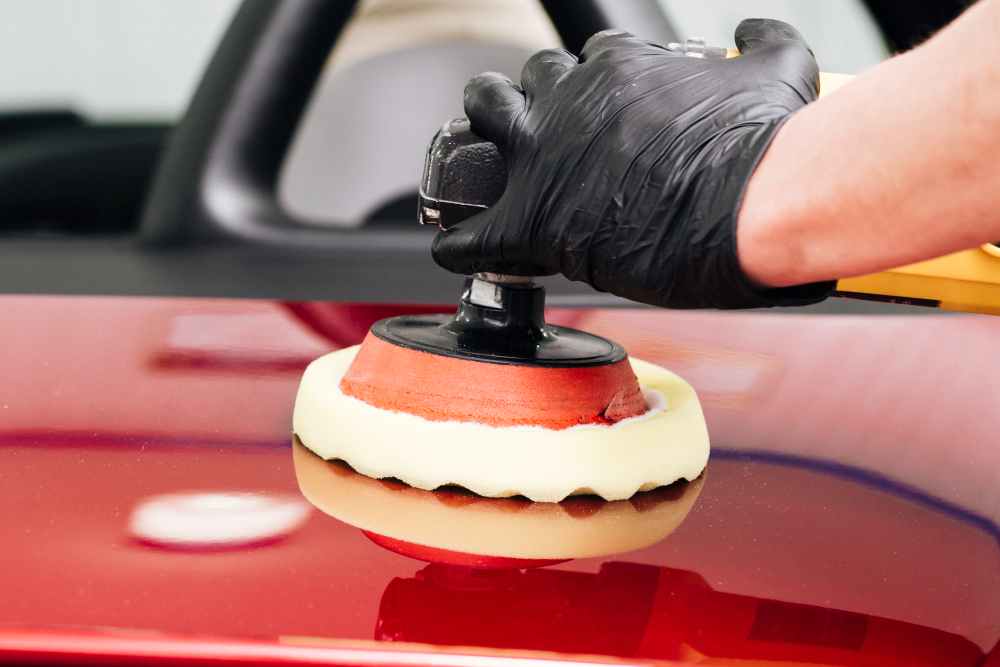
The paint gets washed, decontaminated, clay treated, and usually machine polished to remove swirls and etching. Only then does the coating go on, panel by panel, in a controlled space. On neglected paint, correction takes longer than everything else combined.
That matters when you compare quotes. A price far below everyone else’s is usually skipping correction, which locks in every defect for the next several years.
Where paint protection film beats a coating
If your actual complaint is chips rather than gloss, a coating is the wrong product.
Paint protection film is a thick urethane layer over the panel, and it absorbs impact a coating cannot. Modern films self-heal, so light scratches reflow and disappear with heat. For the bumper, hood, fenders, and mirrors, which take nearly all the rock damage on valley freeways, film is what protects paint.
Plenty of owners run both, with paint protection film on the front end and a coating over the rest. If the budget covers only one and you drive the 15 or 215 daily, film on the front end is the better first purchase.
Who it makes sense for
Coating pays off on a vehicle you plan to keep for four or five years, that parks outside, with paint in good condition or freshly corrected. Dark colors show the benefit most.
It makes less sense on a two-year lease, a garage-kept car that rarely sees sun, or a vehicle whose clear coat is already failing. In that last case, the money belongs in bodywork.
One caution on products. Consumer sprays sold as ceramic are not the same chemistry as a professional coating and do not last the same way. They are closer to a durable sealant, which is fine if you buy them expecting a season rather than years.
Frequently asked questions
1) Is ceramic coating the same as ceramic tint?
No, and the shared word causes constant confusion. Ceramic tint is a window film that rejects heat and UV through the glass. Ceramic coating goes on paint. We cover the film side in our guide to ceramic and standard tint.
2) How long does a ceramic coating last in this climate?
Professional coatings are commonly rated in years rather than months, though desert sun and hard water shorten real-world life compared with mild climates. Maintenance drives the outcome more than the brand does.
3) Can I still take a coated car through a car wash?
Avoid the ones with spinning brushes, which put swirls into the coating and the clear coat beneath it. Touchless washes and proper hand washing are the safer routes.
4) Does a coating remove scratches already in my paint?
No. A coating is clear and cures over what is there. Scratches and swirls have to be polished out before coating, which is why correction is part of a serious quote.
5) Will it stop rock chips on the freeway?
No. That is what paint protection film is for. A coating and film solve different problems and are often used together.
Conclusion
Ceramic coating is worth it here when the goal is gloss retention, UV defense, and spending less time fighting water spots on paint that is still in good shape. It is not worth it as chip protection, as a repair for tired clear coat, or on a car you will hand back in two years.
Ace Built Automotive installs paint protection film, vinyl wraps, and window tint, and we can tell you which of the three fits what you are actually trying to protect. Our FAQ page covers more of the common questions.
Bring the vehicle to the shop on South Decatur so someone can look at the paint first, or reach us at 702.476.9191 and ask for a quote.